
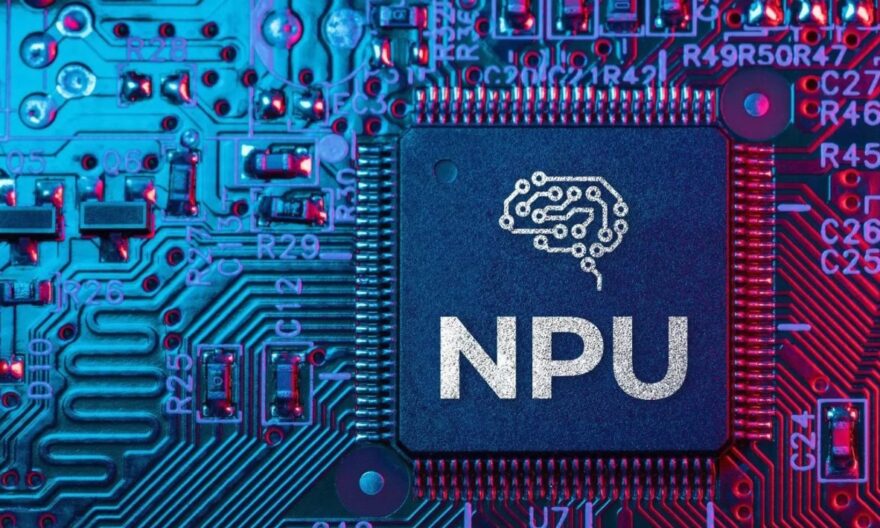
Artificial intelligence has become a central component of modern smartphones, whether it is facial recognition, photo processing, or smart suggestions. To handle these tasks without slowing down the main processor, many manufacturers now integrate NPUs, or AI co-processors, specialized circuits dedicated to AI.
These chips not only accelerate calculations: they enable instant responsiveness, reduced energy consumption, and better accuracy in smart functions.
Unleashing the power of AI without slowing down the smartphone
The NPU, or Neural Processing Unit, is designed to process artificial intelligence algorithms independently of the CPU. Unlike the main processor, which handles all applications and system tasks, the NPU focuses solely on computing AI models.
This allows for complex operations, such as real-time image processing, voice recognition, or text analysis, without overloading the main processor or draining the battery. For example, when taking a photo, the NPU can analyze the scene, detect faces, adjust brightness, and apply color corrections, all while keeping the smartphone smooth for the user.
In practice, this translates into faster and more accurate experiences. Photo or video editing applications, voice assistants, and instant translation systems directly benefit from this dedicated architecture.
How does the NPU improve photography and video?
Photography is one of the areas where the NPU has the most impact. On modern smartphones, it analyzes each image in real-time to adjust sharpness, brightness, color balance, and even reduce noise in low-light conditions.
For example, during an evening shot, the NPU can combine multiple shots at different exposures, automatically correct movements, and produce a brighter and more detailed photo. These calculations, which would be long and energy-consuming on a classic CPU, are performed in a few milliseconds thanks to the AI co-processor.
Video also benefits from these optimizations: stabilization, object tracking, and scene detection are managed in real-time, offering smooth sequences even in complex situations. The result is a smartphone capable of producing professional-quality content without additional equipment.
Accelerated voice assistants and smart functions
Besides photography, the NPU is crucial for voice assistants and smart features. It analyzes commands, detects keywords, and predicts the most relevant responses without relying on the cloud, reducing latency and protecting user privacy.
Applications like automatic transcription, real-time translation, and contextual recommendation rely on these chips. This means a smartphone can offer user-adapted suggestions in a few milliseconds, making the experience smoother and more natural.
Moreover, by processing certain tasks locally, the NPU reduces the need to send data to external servers, optimizing data consumption and security.
Battery optimization and extended performance
One of the most important advantages of the NPU is its positive effect on energy consumption. Complex calculations performed by the CPU or GPU are much more energy-intensive. By delegating AI tasks to the NPU, the smartphone maintains high performance while preserving battery life.
This is particularly noticeable during extended sessions of photography, gaming, or video conferencing. The smartphone remains responsive and does not overheat excessively, offering a stable and pleasant user experience.
This energy optimization also allows manufacturers to integrate thinner and lighter models without compromising power or autonomy.
The future of NPU and AI on smartphones
With the evolution of artificial intelligence, NPUs are becoming increasingly sophisticated. The latest generations can handle more complex neural networks, 3D analysis, and augmented reality. Manufacturers are leveraging these co-processors to enhance user experiences, from immersive gaming to professional photo and video editing tools.
The development of NPUs also paves the way for more advanced local AI, capable of functioning even offline, without compromising speed or accuracy. Tomorrow’s smartphones could thus offer even smarter features while remaining energy-efficient.