
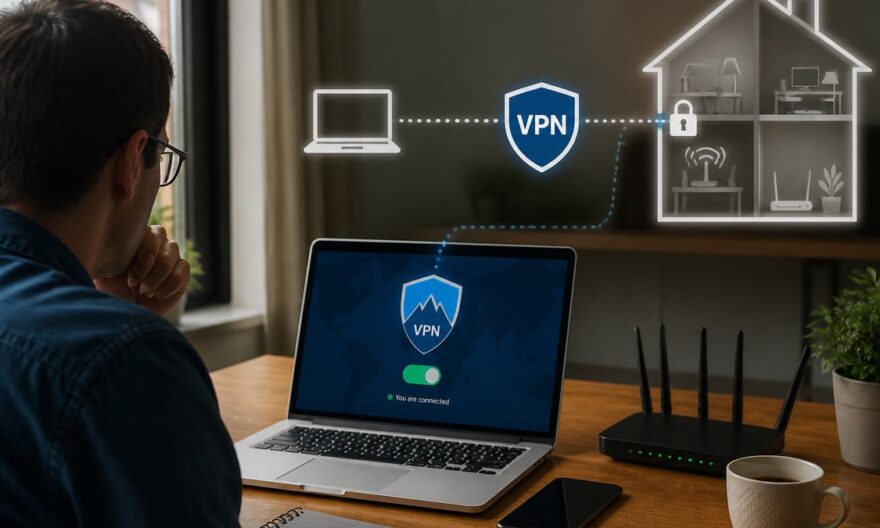
In a world where digital security and remote access are crucial, understanding how to create and use a VPN can transform the way you browse the Internet and access your home network. Discover the reasons for choosing between a commercial VPN service and hosting your own server, as well as the advantages and challenges associated with each option.
Key Takeaways
- Commercial VPN services offer a convenient solution to hide your IP address and secure your Internet connection.
- Hosting your own VPN server allows for complete control over your network and access to your home resources from outside.
- The choice between a commercial service and a personal VPN depends on your specific security and remote access needs.
Have you ever wondered how to protect and manage your data while connecting to the Internet from anywhere in the world? Imagine being able to securely access your home network while traveling abroad. Whether you want to hide your IP address or simply secure your connections, creating a VPN might be the solution you need.
Commercial VPN Services and Their Advantages
Commercial VPN services are popular for their ease of use. These services allow you to hide your IP address and secure your digital exchanges. By using a commercial VPN, your data passes through an encrypted tunnel to the selected server, making your IP address invisible to the websites you visit. Providers often offer dedicated applications for various operating systems, making integration on your devices easier.
These services include advanced features such as the “kill switch,” which cuts the Internet connection if the VPN drops, or “split tunneling,” which allows you to choose which applications use the VPN. Multi-hop connections and dedicated IPs are other common options. Providers manage the servers, reducing technical complexity for the user.
Hosting a Personal VPN Server
For those seeking full control, hosting your own VPN server is a viable option. This involves setting up a server at home, whether through a compatible router or a dedicated device like a Raspberry Pi. This method allows you to access your home network, connect to a NAS, or route your Internet connection through your home.
The main advantage is control over the configuration and resources accessible remotely. However, it requires technical attention, particularly for network configuration and keeping the server updated. Protocols such as WireGuard and OpenVPN are often used for their security and efficiency.
Protocol and Security: Choosing the Right One for Your VPN
The choice of protocol is crucial for the security and performance of your VPN. WireGuard is known for its performance and simplicity, while OpenVPN is appreciated for its compatibility and maturity. IKEv2 is often used for mobile devices due to its stability. Ensure that the chosen protocol uses robust cryptographic primitives to guarantee the security of your data.
The quality of the service does not solely depend on the protocols used but also on key management and the overall security of the infrastructure. The “no-log” promises made by providers should be verified by independent audits to ensure the confidentiality of your data.
Current Trends in the VPN Field in 2026
In 2026, VPNs continue to evolve to meet the growing needs for security and mobility. Providers are developing proprietary protocols to improve the speed and stability of connections. The fight against geoblocking intensifies, and VPN solutions become essential for accessing geographically restricted content.
Moreover, the demand for enhanced privacy features, such as ad and tracker blocking, pushes providers to innovate. The importance of transparency and security audits also becomes a crucial criterion for informed users.
Future Challenges for the Cybersecurity and VPN Sector
The cybersecurity sector, including VPNs, faces growing challenges. With the increase in cyberattacks and hacking threats, VPN companies must strengthen their security protocols. Innovations such as quantum encryption are beginning to emerge, promising new methods to protect digital data.
The legislation surrounding data privacy and VPN usage continues to evolve, influencing how services are provided and used. Players like ExpressVPN and NordVPN are investing in research and development to anticipate these changes and offer cutting-edge solutions.
FAQ on Creating and Using VPNs
What are the advantages of a commercial VPN compared to a personal VPN?
A commercial VPN is easier to use and offers advanced features without requiring complex configuration. It is ideal for those seeking convenience and the ability to hide their IP address from various countries.
Which VPN protocols are most recommended?
WireGuard is often recommended for its performance and simplicity, while OpenVPN is appreciated for its compatibility. IKEv2 is also a good option for mobile devices.
Is it possible to use both a commercial VPN and a personal VPN?
Yes, it is entirely possible to use both types of VPNs. A commercial VPN can be used for travel and everyday use, while a personal VPN can be configured to access your home network.
What are the technical challenges of self-hosting a VPN?
Self-hosting requires ongoing management of hardware, software updates, and network configuration. It also requires a level of technical skill to ensure the security and performance of the server.